GridSim
Documentation site: https://marks0485.github.io/GridSim/ (user manual, technical reference, validation and developer notes, searchable). Wiki: https://github.com/MarkS0485/GridSim/wiki (getting started, install, CLI quick reference, FAQ). Questions: Discussions.
A physics-first power-grid simulator in C# / .NET 10. It starts from a small core (a per-unit network model, the complex bus admittance matrix and a Newton-Raphson load flow) and grows it, deliberately and with every step tested, into a broad grid stack:
- steady state: AC power flow (sparse and dense Newton-Raphson, backward/forward sweep for radial feeders), reactive limits, tap changers, distributed slack and switched shunts, DC power flow, distribution factors, DC-OPF, continuation power flow and loss allocation;
- security: N-1, N-2 and N-1-1 screening, generator-trip and infeed-loss screening, stress to collapse;
- state estimation: weighted least squares and its robust family (Huber, exact LAV, Schweppe-GM, QR, constrained and physically feasible), bad-data identification, observability, a residual-cloaked false-data-injection screen, linear PMU estimation, and dynamic estimation (EKF, UKF, EnKF) in a resident real-time service;
- dynamics: frame-by-frame inertia and frequency (lumped and distributed multi-domain), a PSS/E-class dynamic-model library with multi-machine RMS transient stability and critical clearing time, small-signal modal analysis, impedance-based (generalised Nyquist) stability, and electromagnetic transients;
- faults and protection: IEC 60909 short-circuit duty, sequence-network faults, IDMT overcurrent grading and a passive relay overlay with cascade checking;
- harmonics: frequency-domain penetration, impedance scans, THD and IEEE 519 / G5/5 assessment;
- battery storage: cell-to-pack models, ageing and an LP scheduler;
- an evidence engine that reconstructs recorded GB events and runs grounded counterfactuals on them;
- the real GB network from published data, three-phase distribution feeders, and international starter maps;
- interfaces: MATPOWER, JSON v1/v2, CIM/CGMES, PyPSA, C37.118 synchrophasors, IEC 60870-5-104 and Modbus;
- a web app, a desktop control room, a case editor, and a swappable CPU/GPU solve backend.
Downloads: the latest release is 2.1.073 RC-4, with ready-built Windows, Linux and macOS (Apple silicon) binaries. See Downloads.
Status: unvalidated, and stated plainly. Nothing in GridSim is validated, at any scale, for any purpose. GridSim is written by Mark, an HPC engineer by trade. He has no electrical-engineering training and is not qualified to validate power-system software or to model power systems; his role is the code. What the repository does carry is evidence you can check for yourself: bit-deterministic results, a large test suite, cross-checks against independent open-source tools and benchmark timings, each with its source. GridSim claims no accuracy, no parity with any commercial tool and no fitness for production, planning or operational use.
Use it, and tell us what you find. Results, comparisons with tools you trust, and bug reports are all wanted: send them to mark@gridsimdigitaltwin.co.uk (see Reporting bugs).
Every numerical result is double precision end to end and deterministic to the bit. The core solvers are cross-checked
against independent open-source tools (pandapower, pandapower.estimation, SciPy, published MATPOWER solutions): the
power-flow, harmonic, impedance and small-signal cross-checks gate at 4096 machine epsilons; the state-estimation,
swing-equation, classical-swing and lake-conformance checks compare different algorithms or stopping rules and gate at
stated engineering tolerances (1e-6 pu for the estimator by default). The measured agreement is in
Cross-checks. Agreement with another tool shows that the same equations were solved the same way; it
is not validation against a real power system.
Submodules. This repo contains submodules. No submodule is ever needed for the work: submodules augment and add, they cannot change the core maths. The 36 national and regional network models are the
modelssubmodule: clone withgit clone --recurse-submodules, or rungit submodule update --init modelsin an existing clone. Seedocs/developer/submodules.mdfor more information.
Contents
- What makes GridSim different
- Downloads
- Quick start
- Feature tour
- The maths
- Determinism and machine epsilon
- Cross-checks
- Performance and GPU
- Networks and data
- The apps
- Architecture
- Repository layout
- Assurance and security
- Known limits
- Roadmap
- Documentation
- Licence
- Reporting bugs
- Contributing
What makes GridSim different
-
Physics checks. Every converged state can be audited against the conservation laws it must satisfy (energy, Ohm's law, Joule heating, KCL, complex-power balance). A state that passes the solver's tolerance but breaks a law is reported. Non-converged or invalid results are never reported as success.
-
Inertia is modelled per machine, not as one scalar. The inertia model is a runtime seam (
IInertiaModel): a lumped centre-of-inertia model or a distributed multi-domain model. Each machine is classified by technology as a synchronous swing mass, a synthetic-inertia domain or a pure inverter. The distributed model reports a dominance read-out and collapses exactly to the lumped model in the single-domain limit. -
The steady state needs no swing equation. The power flow solves voltages, angles and flows from the admittance matrix and the injections alone, so a grid with zero rotational inertia solves like any other. The swing equation is a separate, opt-in layer for transients.
-
A historical evidence engine. A state estimator and counterfactual engine estimate what the grid did from public data. A counterfactual runs only after the baseline reproduces the recorded event. The 169-hour no-forward-inference horizon is enforced in code at every dated ingester.
-
Bit-identical results. Results are identical across runs, parallel paths, CPU vector tiers and the dense and sparse power-flow engines, using GridSim's own deterministic maths library (
docs/developer/deterministic-maths.md). The tests are constitutional: a change that breaks one is wrong (CONTRIBUTING.md). -
Double precision throughout. Power flow is
doubleend to end. The GPU backend is AMD-first (ROCm), because the solves are FP64.
Downloads
GridSim ships ready built for anyone who does not want to compile it. The latest release is 2.1.073 RC-4; its notes are in RC4.md (RC-3 is in RC3.md). All builds are self-contained: no .NET install is needed to run them.
| What | Platform | File on the release page |
|---|---|---|
Command line tool (gridsim) |
Windows x64 | gridsim-<version>-win-x64.zip |
Command line tool (gridsim) |
Linux x64 | gridsim-<version>-linux-x64.tar.gz |
Command line tool (gridsim) |
macOS arm64 (Apple silicon) | gridsim-<version>-osx-arm64.tar.gz |
| Desktop app (Avalonia) | Windows x64 | gridsim-app-<version>-win-x64.zip |
| Desktop app (Avalonia) | Linux x64 | gridsim-app-<version>-linux-x64.tar.gz |
| Desktop app (WPF) | Windows x64 | gridsim-wpf-<version>-win-x64.zip |
| CycloneDX SBOMs (tool, apps, core library, web image) | Any | *.sbom.json |
| SHA-256 checksums of every file | Any | SHA256SUMS.txt |
Check every download against SHA256SUMS.txt. The GridSim.Core NuGet package and the replay-only web container
image are published outside the release page; manual ch. 1 says where, and
how to check signatures. There is no macOS desktop app build: Mac users build the desktop app from source with Xcode
and the .NET SDK (exact commands in RC1.md). System requirements are in RC1.md and unchanged
since. Earlier releases stay available on the Releases page.
GridSim.Gda and the GDA data are not release artefacts: there is no GridSim.Gda package and no GDA data in any
download. The gda verbs stay in the CLI, but they read a GDA data lake (GDA_DATA_ROOT), which a release does not
include.
Quick start
Build and test
You need the .NET 10 SDK. From the repository root:
dotnet build GridSim.slnx -c Release
dotnet test  GridSim.slnx -c Release --no-build
The build is warning-free by contract (TreatWarningsAsErrors). The examples below are written as gridsim <verb>:
that is the release binary, or from source dotnet run --project src/GridSim.Cli -c Release -- <verb>. Every verb
answers --help with its usage, flags, defaults and exit codes, and the full reference is
docs/manual/0019 CLI reference.md.
Solve a network
$ gridsim case9 --once
GridSim  -  IEEE 9-bus (WSCC)
9 buses  9 branches  3 generators  base 100 MVA  60 Hz
========================================================================
Converged (4 NR iters, 0 OLTC passes, max mismatch 1.65E-014 p.u.)
Generator output 0.32 GW  Demand 0.32 GW  Losses 4.6 MW  Inertia 7.5 GVAs

Bus  Name                            kV    Vm(pu)  Va(deg)    P(MW)   Q(MVAr)
------------------------------------------------------------------------------
  1                                 345   1.040     0.00      71.6      27.0
  2                                 345   1.025     9.28     163.0       6.7
  3                                 345   1.025     4.66      85.0     -10.9
  4                                 345   1.026    -2.22      -0.0       0.0
  5                                 345   1.013    -3.69     -90.0     -30.0
  6                                 345   1.032     1.97       0.0      -0.0
  7                                 345   1.016     0.73    -100.0     -35.0
  8                                 345   1.026     3.72       0.0       0.0
  9                                 345   0.996    -3.99    -125.0     -50.0
case9 carries its WSCC nominal frequency, 60 Hz; a power flow does not use the frequency.
Other built-in cases that run this way: case14, case30, case57, case118, case300, case145, case24 (RTS),
cigre and uk (the GB reduced 10-zone model, live with no argument). Any MATPOWER file runs the same way, for example
gridsim data/matpower/pegase/case9241pegase.m --once, and --dir <case-dir> loads a JSON case: the full GB network
is gridsim --dir data/gb-full --once and the synthetic GB network gridsim --dir data/gb-synthetic --once. The
names gb-full and gb-synthetic are for the verbs (gridsim pf gb-full), not this bare form.
Estimate the state from measurements
$ gridsim estimate case14 --synth

=== WLS state estimate: case14 ===
  status: Converged   iterations: 5   max |dx|: 2.72E-009
  measurements: 122   states: 27   redundancy (dof): 95
  observability: observable (rank 27/27)
  consistency: J = 80.01 vs chi2(95%) = 118.75 -> PASS
  vs synthetic truth: max |dVm| = 1.330E-003 pu   max |dVa| = 2.248E-001 deg
--synth samples noisy telemetry from a solved truth; --measurements <m.json> reads a dated measurement set (it
must be older than the 169 h horizon). --method selects wls, constrained, feasible, huber, lav (exact LP),
lav-irls, schweppe-gm or qr, and --fdia-screen adds the false-data-injection screen.
Cross-validate against pandapower
gridsim crossval case14
This solves the case, exports the state and re-solves it independently in pandapower (pip install pandapower; the
verb exits 77 if it is missing). The measured agreement on the reference cases is in Cross-checks.
Replay a recorded event
$ gridsim replay-event gb-2019-08-09

=== Replay: GB 9 Aug 2019 disturbance (Hornsea + Little Barford) ===
  when (UTC):        2019-08-09T15:52:33.0000000Z   provenance: DerivedFromRecorded (event tagged Recorded; the weakest of its parts)
  pre-event inertia: 215.0 GVA.s   demand: 21.1 GW   total loss: 2768 MW
  inferred inertia from recorded RoCoF: 223.7 GVA.s (cross-check vs 215.0)

  RoCoF:  sim  -0.171   recorded  -0.170 Hz/s   (1 % error)
  Nadir:  sim   48.84   recorded   48.80 Hz   (0.04 Hz error)
  Nadir envelope (declared-uncertainty corners): [48.20, 49.17] Hz - recorded INSIDE (consistent within the model's own error bars)
  RMSE vs trace: n/a (no 1-sec NESO trace attached - data-gated)
  assessment: BELOW STATUTORY (49.5 Hz)

  VERDICT: REPRODUCED  - baseline reproduces the record; counterfactuals unlocked.
The when line gives the replay's effective provenance, the weakest of its parts: a built-in recorded event reads
DerivedFromRecorded, with the event's own tag in brackets when the two differ.
Once the baseline reproduces the record, scenario, fleet, h0-study and evidence run counterfactuals on it, for
example gridsim scenario --event gb-2019-08-09 --device-inertia 40 --device-ffr 1.5.
Optimal dispatch, short circuit, harmonics and EMT
$ gridsim dcopf case9
DC-OPF - IEEE 9-bus (WSCC) (9 buses)  [cheapest secure dispatch]
  demand 315 MW  generation 315 MW  total cost 15,750 GBP/h  (unconstrained merit order)
  dispatch (by output):
      gen bus 3         270.0 MW  @    50 GBP/MWh
      gen bus 2          35.0 MW  @    50 GBP/MWh
      gen bus 1          10.0 MW  @    50 GBP/MWh

$ gridsim iec60909 case9 --bus 5
IEC 60909 - IEEE 9-bus (WSCC), bus 5, three-phase, Maximum (60 Hz, tb 0.1 s, Tk 1 s)
  Ik''  = 1.4683989584292985 kA  (8.774528526143639 pu)
  ip    = 4.143787818206106 kA  (kappa 1.995438943368623, R/X 0.10501342238071008, meshed network: 1.15 x kappa(R/X), Method B)
  Ib    = 1.4683989584292985 kA    Ik = 1.4683989584292985 kA
  Ith   = 1.4881526648788939 kA  (m 0.027086065637215752)    idc(tb) = 0.03963009392407432 kA
  Zth   = 0.013092788564404878 + j0.12467728665140516 pu

$ gridsim harmonics case9
harmonics: case IEEE 9-bus (WSCC), 1 source(s), orders 24
  synthetic source : 6-pulse-g5 at bus 9, 0.5 pu fundamental (G5 Issue 5 Table B.3 six-pulse profile, the default; --synth-spectrum ideal for the idealised 1/h)
  worst voltage THD : 6.31% at bus 9 (relative to the solved fundamental voltage)
  resonance (bus 9): order 7, |Z|=0.658 pu, sharpness 3.8
  fine sweep peak  : h=7.4750 (448.50 Hz), |Z|=0.688 pu, positive sequence
  IEEE-519         : 0/9 buses compliant

$ gridsim emt case9 --duration 0.01 --dt-us 20 --probe v:5
emt: 2 floating node(s) pinned at 0 V in the initial-condition solve.
emt case9: 500 steps @ 20us, 1 factorization(s), peak |probe| 1.079, 3 ms -> results\emt-out
case9 is studied at its 60 Hz nominal frequency, and iec60909 uses the meshed-network peak factor (Method B).
harmonics injects the G5 six-pulse profile at bus 9 by default and names it on the synthetic source : line.
gridsim stability case9 --rms finds the critical clearing time with the subtransient machine engine,
gridsim modal case9 gives the small-signal eigenvalues, gridsim acopf case9 and gridsim cpf case9 run the
loss-loop dispatch and the loadability limit, and gridsim nminus1 screens every single outage on the GB reduced
model.
Three-phase feeders and real-time estimation
gridsim dist3ph data/dist3ph/ieee123.json
gridsim serve case9 --measurements-dir <dir> --method wls
dist3ph solves an unbalanced three-phase feeder (the IEEE 123-node feeder and the IEEE 4-node transformer test
feeders are bundled) and also runs faults, estimation and harmonics on it. serve is the resident real-time
estimator: it streams measurement windows through WLS, EKF, UKF or EnKF, and refuses any window newer than the
horizon:
$ gridsim serve case9 --measurements-dir results/realtime/windows --method wls
serving wls estimator over 4 window(s) from results/realtime/windows
horizon guard: now=2026-10-04T18:39:00.7522631Z, newest processable=2026-09-27T17:39:00.7522631Z
  #0 2024-03-01T12:00:00.0000000Z OK J=47.35 chi2=PASS
  #1 2024-03-01T12:01:00.0000000Z OK J=61.17 chi2=PASS
  #2 2024-03-01T12:02:00.0000000Z OK J=44.61 chi2=PASS
  #3 2024-03-01T12:03:00.0000000Z OK J=53.41 chi2=PASS
done: processed 4, converged 4, rejected-fresh 0, failed 0
The web app and the desktop app
docker compose up -d --build                  # replay-only web app on http://127.0.0.1:5540/
dotnet run --project src/GridSim.Web          # from source, on http://localhost:5180
dotnet run --project src/GridSim.Wpf          # the WPF desktop control room (Windows)
dotnet run --project src/GridSim.App.Desktop   # the Avalonia desktop app (Windows, Linux)
Feature tour
Each area lists its verbs and the chapters that document it: the user manual says how to use it, the technical manual says how it works, with the equations, the invariants and the tests that pin them.
Power flow
AC power flow by Newton-Raphson in polar form. The sparse engine (Gilbert-Peierls LU over an exact minimum-degree
column ordering, which replaced reverse Cuthill-McKee in 2.1.073) runs every meshed network by default; the dense engine is selectable and gives the same bits. Radial
feeders use the backward/forward sweep (--bfs). Reactive limits switch PV buses to PQ, on-load tap changers
regulate in an outer loop, and pf adds distributed slack and switched shunts. Every solve can be exported with its
full trace (Y-bus, specification, every iteration and Jacobian) for independent checking.
Verbs: (no verb), pf, batchsolve, export. Chapters:
manual 5,
technical 2,
technical 3,
technical 4.
DC power flow, OPF, CPF, taps and losses
DC power flow and the PTDF / LODF distribution factors; a DC optimal power flow (bounded simplex, security-constrained,
quadratic and costed forms, with nodal prices); acopf, a DC-OPF dispatch with an AC loss loop; acopf-full, the full
AC optimal power flow (interior point, with voltage, reactive and branch MVA limits); scopf, a preventive
security-constrained DC OPF over single-branch outages; scuc, security-constrained unit commitment (mixed-integer,
GridSim's own branch-and-bound); continuation power flow for maximum loadability; coordinated OLTC scheduling; loss
allocation; and a black-start restoration sequence check.
Verbs: dcpf, ptdf, lodf, dcopf, acopf, acopf-full, scopf, scuc, cpf, taps, losses, restore.
Chapters:
manual 6,
technical 29.
Contingency and security analysis
Branch, generator and bus N-1, N-2 and N-1-1 screening against thermal and voltage limits, a parallel N-1 sweep with
throughput, infeed-loss screening against GB limits, generator trips with RoCoF, nadir and settling, stress to
voltage collapse, warm-started chains of consecutive solves and a prioritised analysis cycle.
Verbs: nminus1, nminus2, n-1-1, nminus1-sweep, screen, trip, stress, chain, cycle. Chapters:
manual 11,
technical 23.
State estimation
The classical estimator z = h(x) + e solved by Gauss-Newton on the normal equations, with a QR alternative, a
trust-region step cap and a choice of method: weighted least squares, Huber, exact least absolute value (an LP),
IRLS LAV, Schweppe-GM with leverage down-weighting, the constrained (KKT) form and the physically feasible form, which
rejects a converged state that breaks a hard physical law. Around it: observability analysis, the chi-square
consistency test, largest normalised residual and hypothesis-testing bad-data identification, state covariance, a
noise-floor study, and the FDIA screen, which flags a measurement-consistent estimate whose state is physically
implausible (the signature of a residual-cloaked false-data injection). pmu-estimate runs the linear
synchrophasor estimator.
Verbs: estimate, estimate-noise-floor, pmu-estimate, crossval. Chapters:
manual 21,
manual 22,
technical 6,
technical 16.
Real-time and dynamic estimation
serve runs a resident estimator over a stream of measurement windows: static WLS, or dynamic state estimation with
an extended, unscented or ensemble Kalman filter, plus a frequency and RoCoF filter. Every window passes the horizon
guard first, and the run is recorded in the audit log. The web host runs the same engine as a hosted service.
Verbs: serve. Chapters:
manual 23,
technical 18.
Three-phase distribution
Unbalanced three-phase feeders with single- and two-phase laterals, regulators, switches and capacitor banks: a
three-phase backward/forward sweep, sequence-network fault studies, three-phase WLS and branch-current state
estimation, and three-phase harmonic penetration. The model is marked experimental.
Verbs: dist3ph. Chapters: manual 7,
technical 18.
Frequency and inertia
The lumped centre-of-inertia swing with governor droop and load damping, and the distributed multi-domain model with
Kron-coupled domains, propagation delay and dominance; grid-forming inverter support; NESO 1-second frequency
statistics; terminal frequency replay; distributed-inertia domains; and fitting swing constants to a recorded trace.
Verbs: freq, replay, transient, domains, fit-frequency. Chapters:
manual 14,
technical 5,
docs/validation/distributed-inertia.md.
RMS dynamics, small-signal and impedance stability
The machine hierarchy from classical through one-axis and two-axis to subtransient (GENROU) with saturation; the
exciters, stabilisers and governors (SEXS, IEEET1, PSS1A, TGOV1, IEEEG1, hydro) and a REGC_A-style converter; the
multi-machine RMS transient-stability engine with critical clearing time search; small-signal eigenvalues, damping
and participation factors; and impedance-based stability with the generalised Nyquist criterion and critical short
circuit ratio.
Verbs: stability, modal, impedance-stability. Chapters:
manual 15,
technical 24,
technical 30.
Electromagnetic transients
A Dommel-method EMT solver: trapezoidal and backward-Euler companion models, Bergeron travelling-wave lines, critical
damping adjustment, switching events and probes.
Verbs: emt. Chapters: manual 16,
technical 21.
Harmonics
Frequency-dependent network admittance (skin effect, long-line correction), harmonic source injection and
penetration, impedance scans and fine frequency sweeps for resonance, voltage THD, and compliance against IEEE 519 and
Engineering Recommendation G5/5.
Verbs: harmonics. Chapters: manual 17,
technical 19.
Faults, short circuit and protection
Sequence-network faults (three-phase, line-to-ground, line-to-line, double line-to-ground); the IEC 60909-0 duty study
(the equivalent voltage source, Ik'', ip by methods B and C, Ib with the near-generator breaking factor, Ith, the
decaying DC component, and the impedance correction factors with --corrections); IDMT overcurrent grading to IEC
60255 and IEEE C37.112 curves; a passive relay overlay; and cascade validation.
Verbs: fault, iec60909, grade, protection-check. Chapters:
manual 12,
technical 15,
technical 17,
technical 25,
technical 26.
Battery storage
Cell equivalent-circuit models for six chemistries, packs, rainflow ageing and an LP storage scheduler, carried
through time series (chain, gda-replay).
Chapters: manual 13,
technical 27.
The evidence engine
Recorded events with sourced figures pass a credibility gate (replay-event) before any counterfactual is allowed:
scenario sweeps device inertia and fast frequency response and draws a risk curve, fleet compares one large unit
with a fleet of small ones, h0-study asks what a zero-inertia grid would have done, and evidence assembles a
dossier. Every figure carries a provenance tag (recorded, derived, curated placeholder, synthetic, counterfactual).
Verbs: replay-event, scenario, fleet, h0-study, evidence. Chapters:
manual 18,
manual 20,
technical 7,
technical 13,
technical 14.
The GDA bridge and GB history
GDA materialises GB networks from a data lake of public sources (DNO long-term development statements, NESO data,
CSV and Parquet), and gda-replay reconstructs the grid state at each past settlement period. synth builds a
synthetic GB-at-scale network; zonal reads the PyPSA-GB zonal model.
Verbs: gda, gda-replay, synth, zonal. Chapters: manual 24,
technical 9.
Live telemetry: the RTU interposer and synchrophasors
interpose is a passive tap on IEC 60870-5-104 or Modbus traffic that decodes RTU frames into measurement windows;
live frames feed the estimator only after ageing past the horizon, and are held in a quarantine store outside the
evidence lake until then. pmu-ingest reads IEEE C37.118 synchrophasor data from a capture or a live stream.
Verbs: interpose, pmu-ingest, pmu-estimate. Chapters:
manual 25,
technical 20,
technical 33.
Formats and interfaces
MATPOWER .m (import and export), JSON cases (v1 and the v2 schema with its own validator), CIM/CGMES import, export
and a controlled power flow (in the library), PyPSA-GB, C37.118, IEC 104 and Modbus. DNP3 and IEC 61850 GOOSE are
supported at the framing level only. Results go to the console or to JSON and CSV with --json, --csv or --out.
Verbs: convert, validate, export. Chapters:
manual 31,
technical 10,
technical 28,
technical 32.
Physics audit and validation tools
physics-check and conformance audit any solved state against the conservation laws; crossval re-solves it in an
independent tool; bench, simdcheck and gpucheck measure and check the compute.
Chapters: manual 27,
technical 11,
technical 16.
Study jobs (RC-3 and RC-4)
RC-3 added transmission study jobs as separate commands, each reading a strict JSON study file bound to its case by
SHA-256: transmission-security, cgmes-study, transfer-capability, corrective-sequence, dynamics-study,
planning-study, restoration-study, reliability-study, emt-line, arc-flash, cable-rating and motor-start
(RC3.md). RC-4 adds study-case management, sensitivity and contingency verbs, probabilistic
and network reliability studies, line constants, a resident rpc endpoint, further short-circuit and protection duty
verbs, declarative dynamic models, full-model small-signal analysis, node-breaker exchange, meshed unbalanced
distribution, three-phase EMT, a workbench and UK power-quality checks (RC4.md). Each job reports what it
could not establish as incomplete, never as a pass, and each is tested on small analytical, constructed or synthetic
cases only. The CLI reference documents every verb.
The maths
The formulations, in brief; each technical chapter derives them in full, names the source symbols and lists the tests that pin them.
Network model (technical 2). Each branch is a
pi-section with series admittance ys = 1/(R + jX), shunt charging bc at each end and complex tap a:
Yff = (ys + bc) / a^2        Ytt = ys + bc
Yft = -ys / conj(tap)        Ytf = -ys / tap
stamped into the sparse bus admittance matrix Y = G + jB in a fixed order so that dense and sparse assembly agree to
the bit. The asymmetric Yft != Ytf is what makes a phase shifter move flow.
Power flow (technical 3). The injections at bus i:
P_i = Vm_i * sum_k Vm_k (G_ik cos th_ik + B_ik sin th_ik)
Q_i = Vm_i * sum_k Vm_k (G_ik sin th_ik - B_ik cos th_ik)
Newton-Raphson drives the mismatch f(x) = [P_spec - P(x); Q_spec - Q(x)] to zero with the polar Jacobian blocks
H = dP/dth, N = Vm dP/dVm, M = dQ/dth, L = Vm dQ/dVm, factorised by sparse LU each iteration. Reactive limits
and tap changers are outer loops; the backward/forward sweep solves radial feeders branch by branch.
DC power flow and OPF (technical 29).
P = B' th; PTDF and LODF follow from B'; the DC-OPF minimises dispatch cost subject to the DC flow equations and
line limits, and the dual of the balance constraint gives the nodal price.
State estimation (technical 6). Minimise
J(x) = sum_i ((z_i - h_i(x)) / sigma_i)^2. Each Gauss-Newton step solves the normal equations
G(x) dx = H^T W (z - h(x)), G = H^T W H, W = diag(1 / sigma_i^2)
The chi-square test compares J with the quantile at m - n degrees of freedom. The residual covariance
Omega = R - H G^-1 H^T gives normalised residuals r_N,i = |r_i| / sqrt(Omega_ii) for bad-data identification.
Robust methods reweight the same equations (Huber with k = 1.345, Schweppe-GM with leverage down-weighting); exact
LAV is a linear programme; the constrained form solves the Hachtel KKT system.
Dynamic estimation (technical 18).
The EKF predicts P- = F P F^T + Q and corrects with the measurement Jacobian; the UKF propagates sigma points; the
EnKF propagates a seeded ensemble.
Frequency dynamics (technical 5). The lumped swing:
df/dt = f0 / (2 E) * (P_m - P_e), with E the stored kinetic energy in GVA.s. The distributed model couples domains
by P_tie,i = sum_j K_ij (delta_i - delta_j(t - tau_ij)) and integrates with symplectic Euler; the inverse form
E = f |dP| / (2 |RoCoF|) infers inertia from a recorded event.
Machines and controls (technical 24). The swing of
each machine, domega/dt = (Pm - Pe - D*omega) / (2*H) and ddelta/dt = ws*omega, with one-axis, two-axis and
subtransient flux dynamics and the standard exciter, stabiliser and governor block diagrams.
Small-signal and impedance (technical 30).
Linearise to dx/dt = A x; each eigenvalue s = sigma + j w has damping ratio zeta = -sigma / |s|.
Impedance stability applies the generalised Nyquist criterion to the converter and grid admittances.
Electromagnetic transients (technical 21).
Each step solves the nodal equation G v = i_hist + i_src; a trapezoidal inductor is the companion conductance
2L/dt (in series with its resistance) plus a history current source; lines are Bergeron travelling-wave models.
Short circuit (technical 25). The equivalent
voltage source c Un / sqrt(3) at the fault (c = 1.10 or 1.00 above 1 kV for maximum and minimum currents);
Ik'' = c Un / (sqrt(3) |Zk|); the peak ip = kappa sqrt(2) Ik'' with kappa = 1.02 + 0.98 e^(-3 R/X); the
thermal equivalent Ith = Ik'' sqrt(m + n).
Harmonics (technical 19). The network admittance is rebuilt at each order
Y(h); injections give V(h) = Y(h)^-1 I(h); THD_V = sqrt(sum_h |V_h|^2) / |V_1|.
Battery storage (technical 27). A cell equivalent circuit (open-circuit voltage against state of charge, series resistance and RC branches), rainflow-counted cycle ageing, and a scheduling LP.
Determinism and machine epsilon
GridSim treats bit-identical results as a requirement, not an aspiration. The overview is docs/developer/deterministic-maths.md and the
specification is technical ch. 38, Deterministic mathematics:
-
Deterministic maths. Transcendental functions come from
DetMath, a C# port of FDLIBM 5.3 checked bit for bit against Java'sStrictMath, so they round the same way on every operating system. No numerical path uses fused multiply-add. An IL-level analyser test (DeterministicMathGuardTests) fails the test run if numerical code calls the platform maths library, a fused multiply-add or a horizontal vector reduction. The one allowed exception is the fused arm ofSimdKernels.AddScaledRow, which no numerical path selects. The full rules are indocs/developer/deterministic-maths.md. -
SIMD tiers. Dense kernels dispatch to AVX-512, AVX2, SSE or scalar at run time and give the same bits at every width;
gridsim simdcheckreports the active tier. CI (.github/workflows/ci.yml) runs the suite on Linux and Windows x64 (normal, AVX2 off with FMA off, hardware intrinsics off, forced AVX-512 and forced 256-bit), on macOS (Apple silicon; normal and hardware intrinsics off) and on Linux and Windows ARM64 (normal and hardware intrinsics off). CI does not run on every push: the release workflow calls it on a release tag and publishes nothing unless every leg passed (it can also be started by hand); day-to-day verification is a local batch run. -
Dense and sparse power flow agree to the bit (
DenseSparseParityTests: every bit, iteration count and status equal), as do routed and explicit engine choices. -
Estimates and replays are bit-reproducible run to run on each backend, and no estimation arithmetic reads the clock. The forward-inference horizon does: which windows are accepted depends on when a run happens, unless
--utc-nowpins it. -
The live analysis cycle is the one scheduling exception.
cycleand the live web cycle admit their Low-priority jobs against a wall-clock budget, so which jobs run in a cycle depends on the machine; each job that runs is itself deterministic (technical ch. 8). -
The state estimate does not depend on the bus count. On the CPU every WLS and robust estimate takes the same sparse step at every size (
CanonicalWlsParityTests: bit-identical across the old 200-bus dense / sparse threshold). -
BREAKING CHANGE in RC-4 (2.1.073). Results and determinism digests are not bit-identical to 2.1.071 or 2.1.072, because the sparse LU ordering and the Newton voltage floor changed; within one version, bit identity holds as above. The difference is at rounding level (on 66 MATPOWER cases at most 9.7e-13 pu in voltage magnitude and 1.9e-11 deg in angle, with identical convergence and iteration counts); stored digests must be regenerated. Details are in RC4.md.
Open items, stated plainly: the dense estimator step that a GPU linear solver uses agrees with the sparse step to solver tolerance (Vm 1e-8 pu, Va 1e-7 deg), not to the bit; GPU arithmetic is outside the bit-identity contract. Every CI leg, Linux and macOS included, is a hard gate on the same pins.
Cross-checks
Every figure below is a measured number with its source. Each one measures agreement with an independent tool, a published solution or a published event record; none of them validates GridSim against a real power system, and no comparison with a commercial tool (PSS/E, PowerWorld, PowerFactory, PSCAD/EMTP) has been made. The figures below were measured before the RC-4 ordering change, which moves results at rounding level only.
Power flow against pandapower (pandapower 3.5.5, measured 2026-10-05; gb-full re-measured 2026-10-31 after the 2.0.200 charging correction; worst |V| pu / angle rad; gate 4096 machine epsilons, 9.09e-13; technical 11):
| Case | Vm (pu) | Va (rad) |
|---|---|---|
| case9 | 4.4e-16 | 7.0e-17 |
| case14 | 4.4e-16 | 1.1e-15 |
| case30 | 6.7e-16 | 1.7e-15 |
| case57 | 1.8e-15 | 3.5e-15 |
| case118 | 8.9e-16 | 2.7e-15 |
| case300 | 5.2e-14 | 8.7e-14 |
| gb-synthetic | 1.9e-14 | 3.9e-14 |
| gb-full | 3.3e-13 | 3.0e-13 |
State estimation against pandapower.estimation (technical 11): case14 5.56e-12 pu and 7.74e-11 deg; case30
4.44e-16 pu; case118 2.36e-13 pu. An independent NumPy check confirms each estimate's residuals (3.877e-13 on case14),
its objective and its optimality.
Other independent checks (technical 11): case9 against the published MATPOWER solution (4 iterations, mismatch 1.6e-14, loss 4.641 MW); the swing equation against SciPy RK45 (1.6e-4 Hz/s and 2.2e-4 Hz on a 1,320 MW loss); the classical multi-machine swing against SciPy (3.7e-8 rad on case9); small-signal eigenvalues (3.1e-8 relative on case9 at an eigenvector condition number of 1.9e10); harmonic penetration (9.7e-17 pu).
Recorded events. The 9 August 2019 disturbance: simulated RoCoF -0.171 against a recorded -0.170 Hz/s, nadir 48.84
against 48.80 Hz, verdict REPRODUCED (docs/validation/evidence-gb-2019-08-09.md). The 22
December 2023 event: verdict MARGINAL, RMSE 0.281 Hz against the 1-second trace, with the reasons
(docs/validation/evidence-gb-2023-12-22.md).
Performance and GPU
Every timing here comes from a benchmark run recorded in the repository. gridsim bench runs a matrix of engines over
the case library. On the largest meshed case, case9241pegase, the sparse engine took 1,178 ms where the dense engine
took 199,934 ms, with the same iteration count and the same mismatch (6 iterations, 2.13E-009)
(manual 28; measured before the RC-4 ordering change). With the
minimum-degree ordering of RC-4, large sparse solves are 4 to 7 times faster on an EPYC 7763 server
(case_ACTIVSg2000 306 to 46 ms, case3375wp 560 to 83 ms; RC4.md). Server sweeps reach the 25,000-bus
synthetic cases; the benchmark landing page lists the measured runs, the latest first.
The GPU backend sits behind the same linear-solver seam as the CPU: native ROCm (hipSOLVER, rocSPARSE) for AMD
Instinct first, then OpenCL and CUDA through ILGPU, chosen automatically (gridsim gpucheck reports what is
available). GPU results are deterministic but not bit-identical with the CPU contract: the device runs different
algorithms (natural-order dense elimination, Jacobi-preconditioned BiCGSTAB to a 1e-10 residual), sums in a
different order and fuses multiply-add. Measured on an RTX A4000 over 27 MATPOWER cases they differ from the CPU by at
most 1.45e-12 pu and 5.2e-11 deg, with the same convergence and iteration counts; the 4096-epsilon cross-check gate does not apply to GPU
paths. A GPU solve prints how many of its Newton steps fell back to the CPU LU.
Technical 4, docs/developer/gpu-rental-runbook.md.
Networks and data
| Network | Size | Where |
|---|---|---|
| IEEE 9, 14, 30, 57, 118, 145, 300; RTS 24; CIGRE | built in | gridsim case9 and so on |
| GB reduced (10 zones) | 20 buses | data/uk, gridsim uk |
| GB full transmission model | 3,539 buses, 5,918 branches | data/gb-full |
| GB synthetic at scale | 2,227 buses, 2,268 branches | data/gb-synthetic |
| GB reduced 29-bus, GB network 2224-bus, PyPSA-GB reduced and zonal | MATPOWER | data/matpower/gb |
| PEGASE, RTS, NESTA, PGLib and benchmark libraries | MATPOWER | data/matpower (docs/developer/case-libraries.md) |
| International starter maps: Ireland, Iberia, France, continental Europe | 60 to 5,824 buses | data/intl |
| Three-phase feeders: IEEE 123-node and the IEEE 4-node transformer tests | JSON | data/dist3ph |
| Recorded events, NESO frequency samples | JSON, CSV | data/events, data/neso |
National and regional network models, 36 grids (UnvalidatedAtScale) |
36 to 5,771 buses | models/<case> (the models submodule, fetched with git submodule update --init models; list in models/README.md). Not bundled, so the licence bus limit applies: eight cases are above 1,500 buses and need a licence, issued free of charge at present on request (see Licence) |
The estimated GB history is built on gb-spine, a 316-bus fold of the full model
(manual 22). Network models from the GDA lake are materialised at run
time and never committed. The GB grid documents that GridSim's cited values come from are in the docs/Public/GB
submodule; values whose settling document is paywalled are listed in docs/reference/paywalls.md, with what public
sources confirm and where you set each value yourself.
The apps
- Web app (
GridSim.Web, Blazor): the control room in the browser, a REST and WebSocket API, single sign-on and sessions. In production it runs replay-only, so the solve API and the simulation socket are not served. Manual 9, technical 34, technical 35. - Desktop apps: the live control-room dashboard, the network map, analysis views and the audit log, in two builds.
The Avalonia app (
GridSim.App.Desktop) runs on Windows and Linux; the WPF app (GridSim.Wpf) runs on Windows only. Manual 8, manual 10. - Case editor (
GridSim.SchemaEditor): builds and edits v2 JSON cases. Manual 33. - Workbench (RC-4): a model browser, plot kit, reports and an undoable single-line editor, in the
Avalonia app (Ctrl+Shift+B) and the web client (
/workbench/{case}).
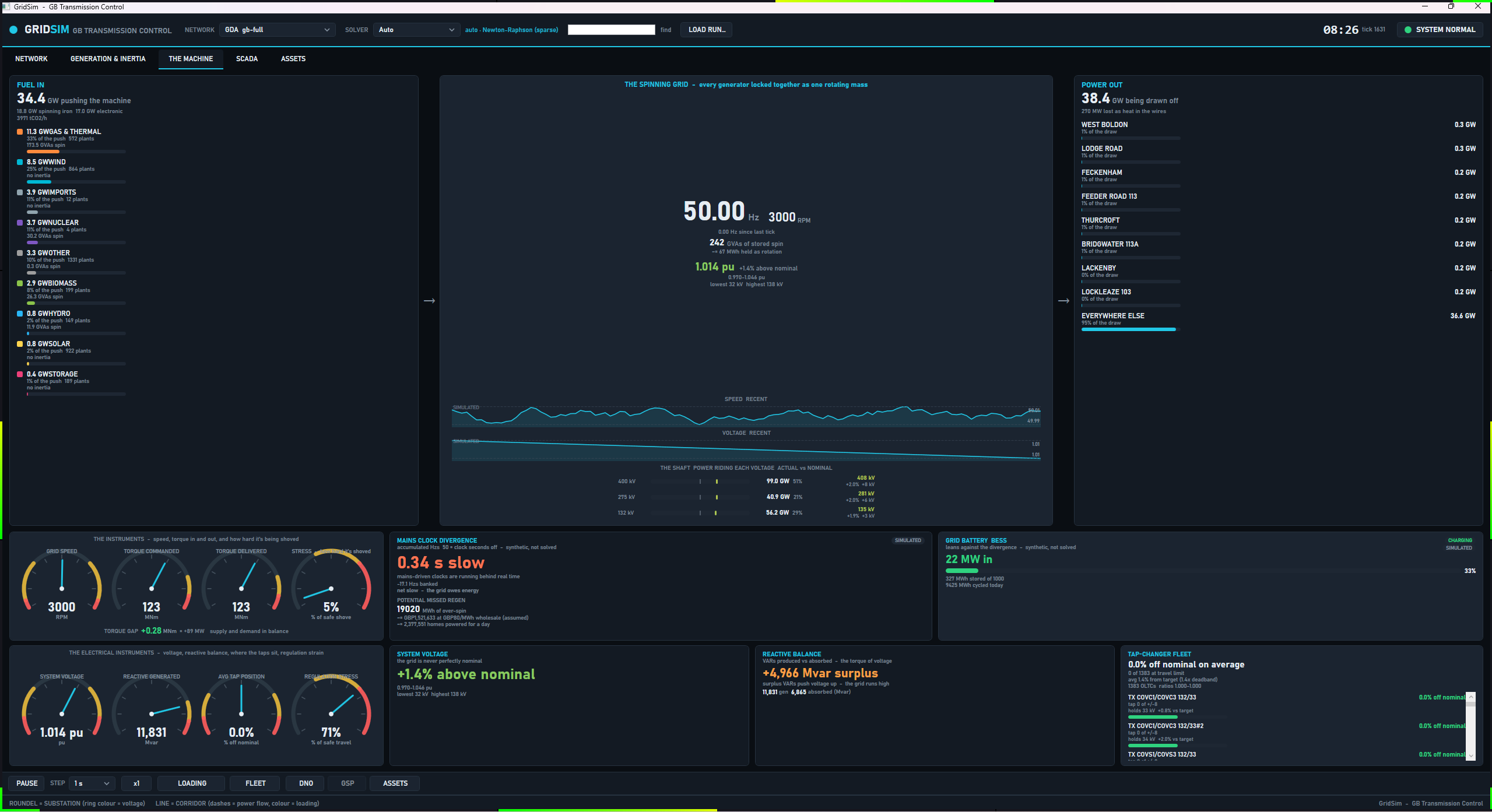
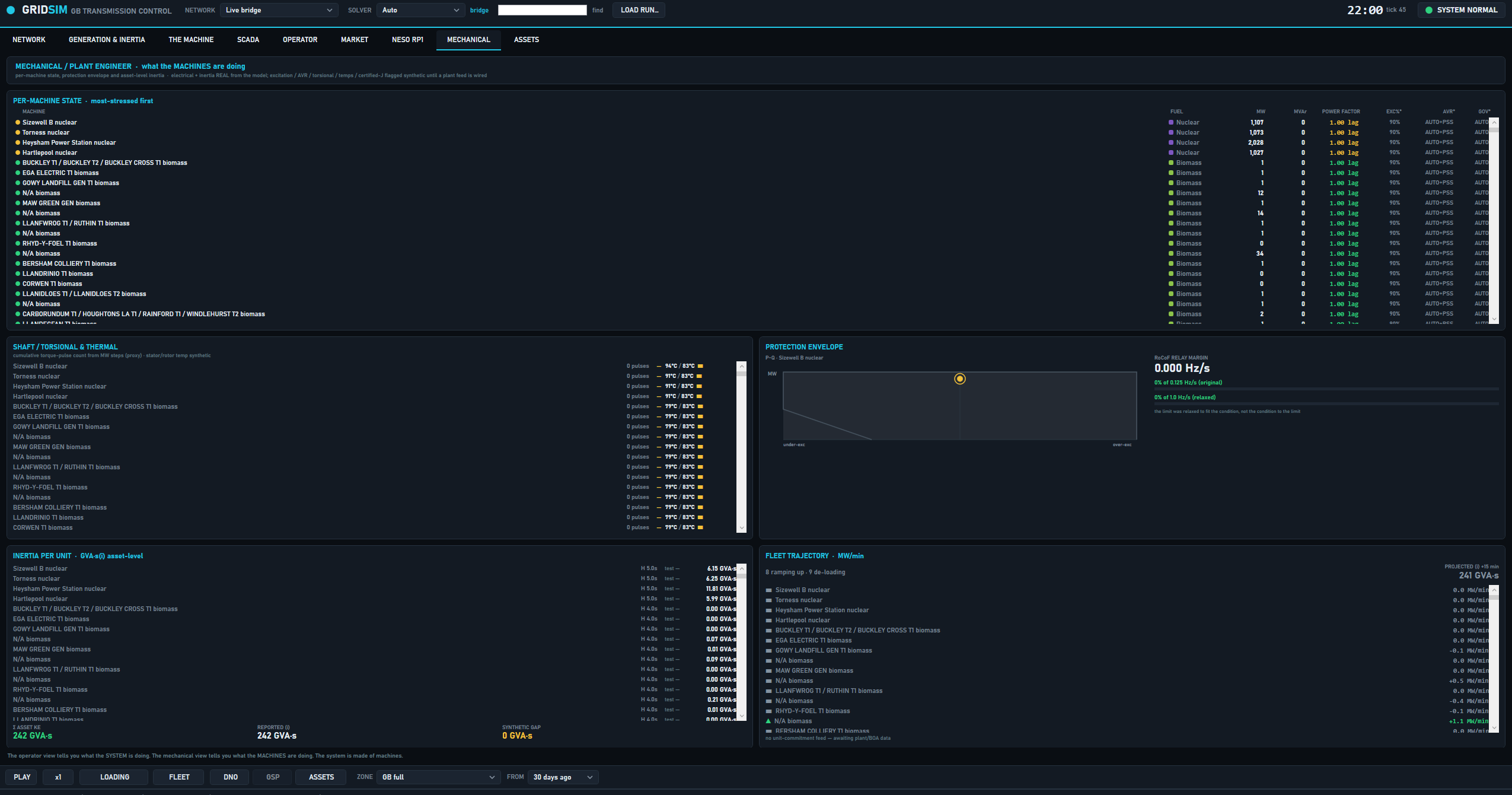
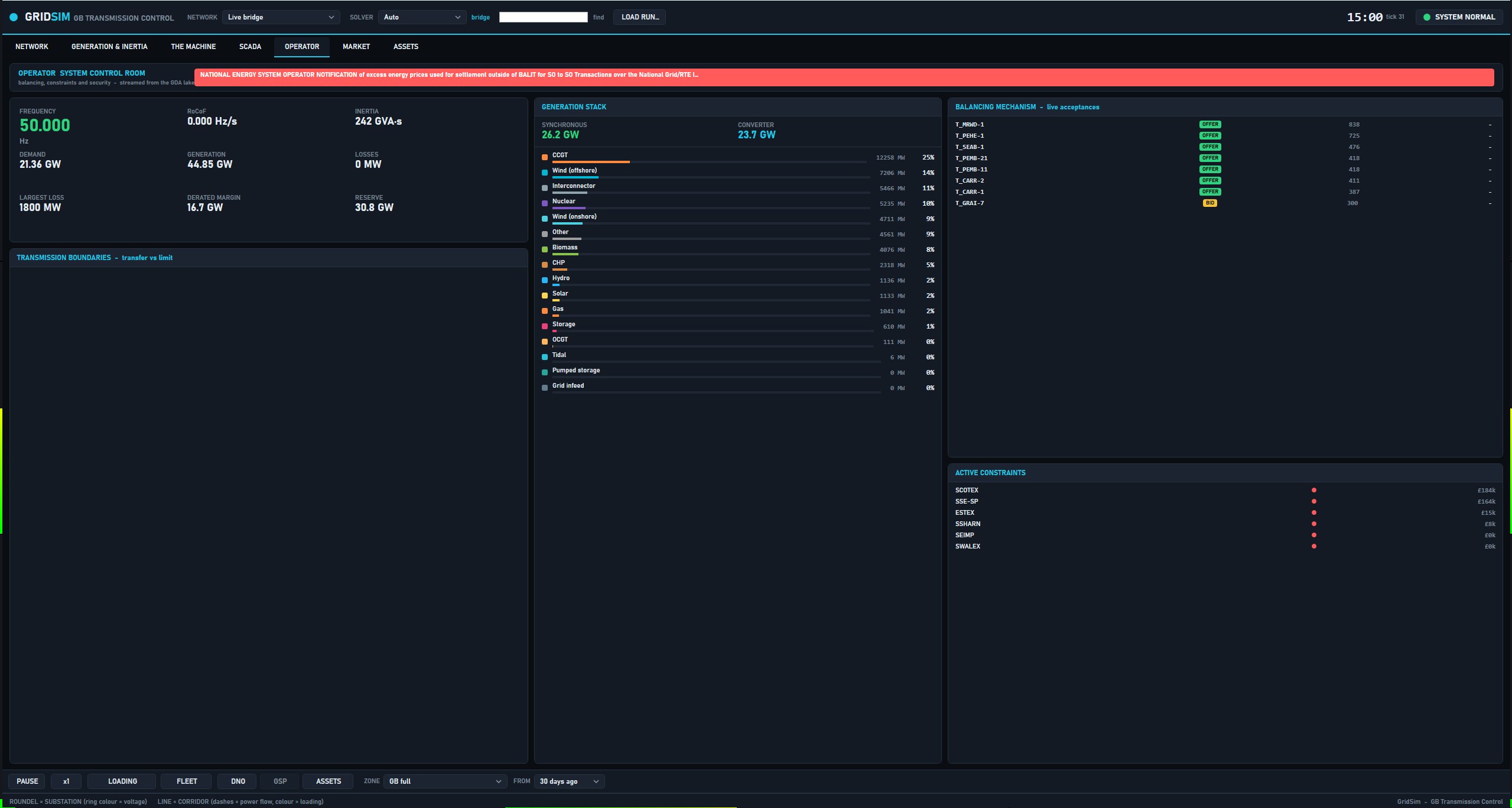
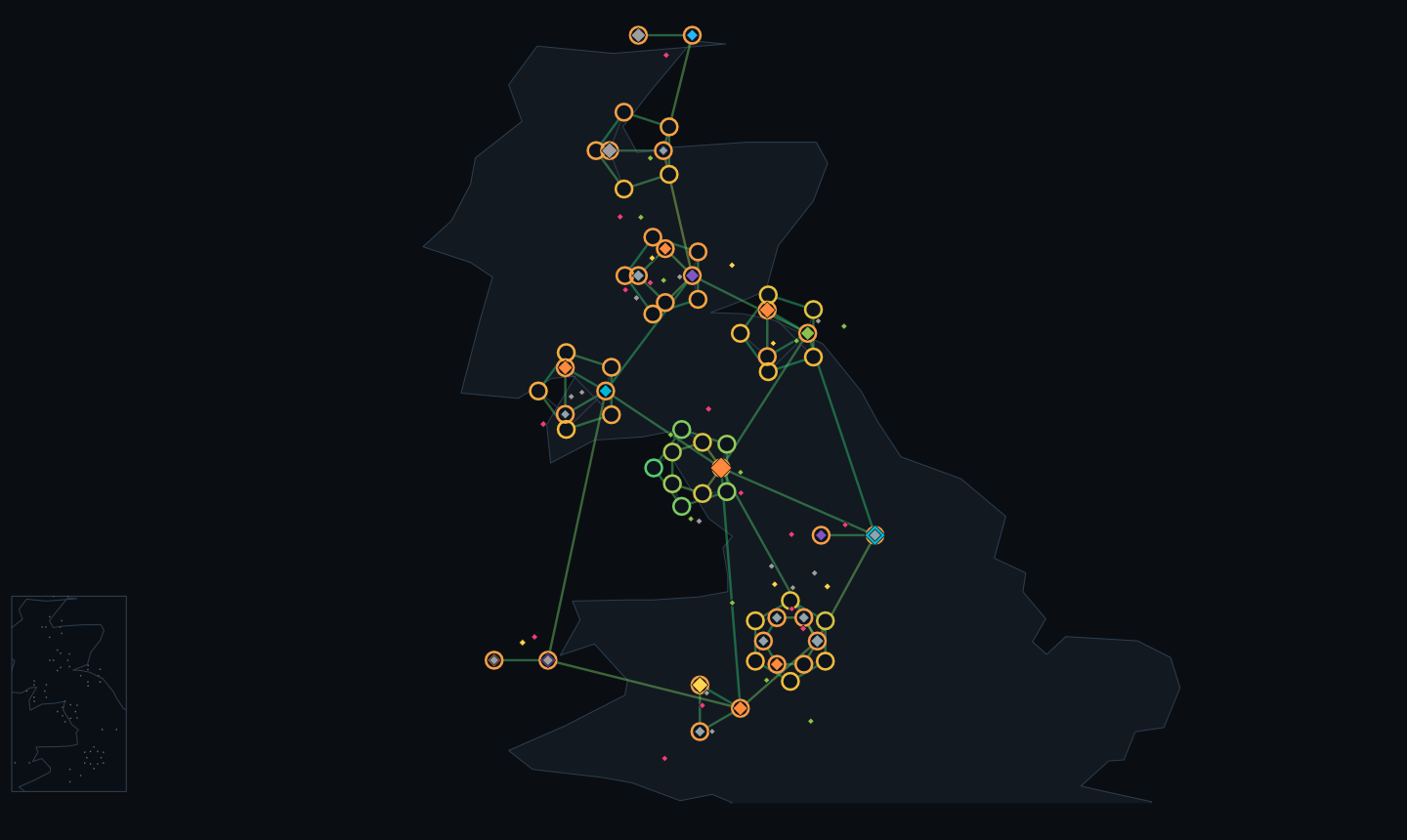
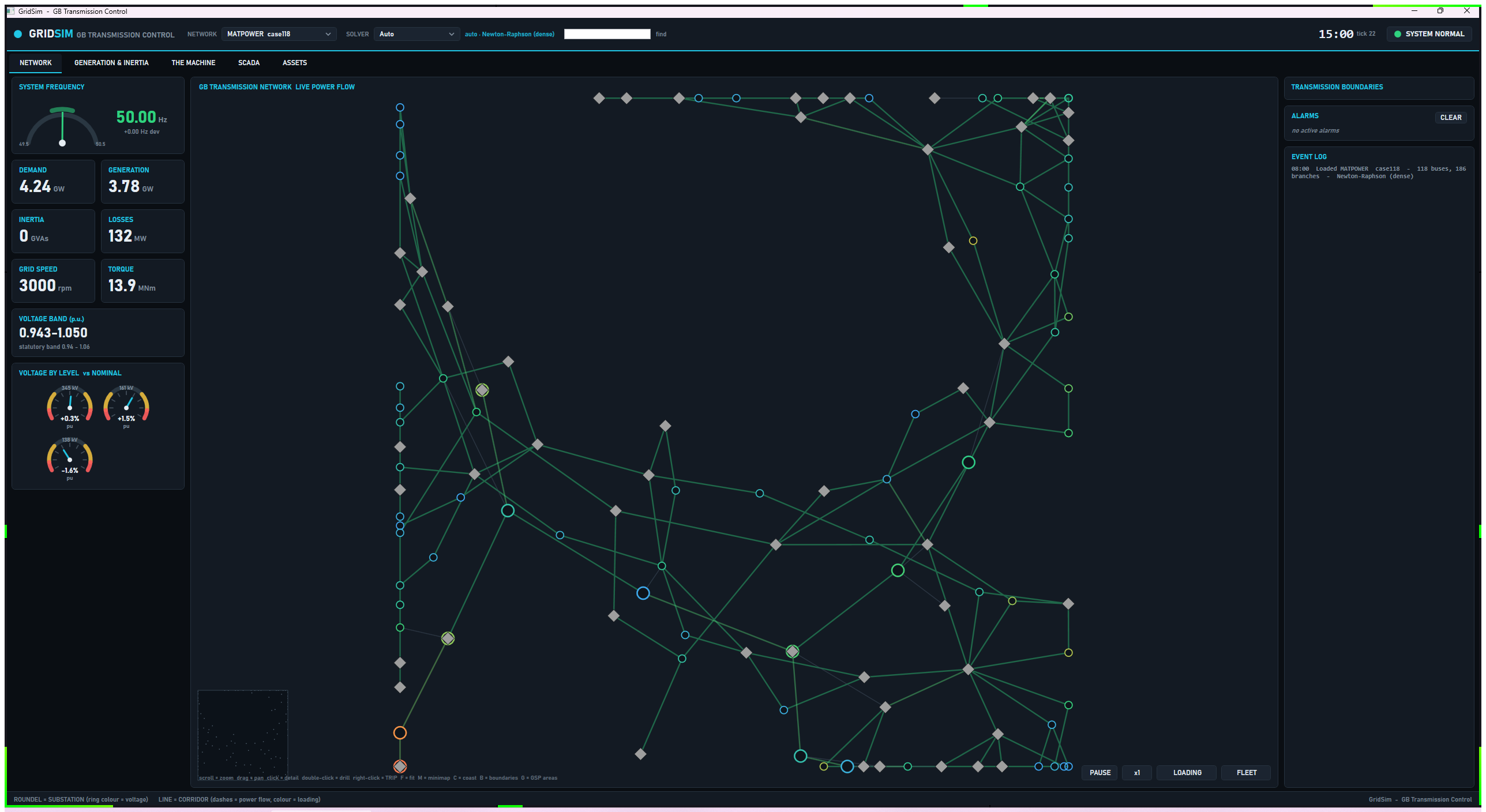
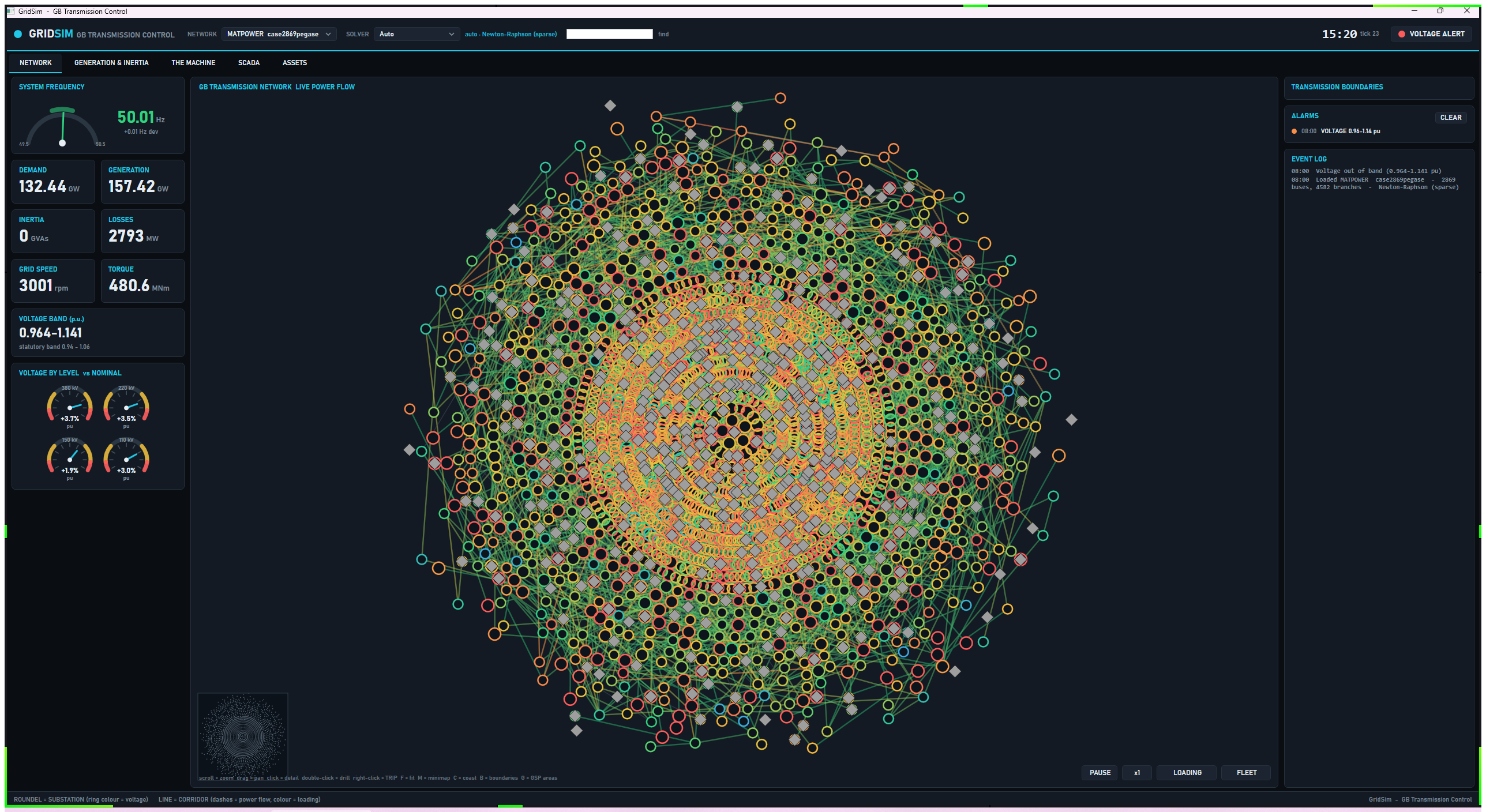
More in docs/screenshots/.
Architecture
GridSim.Core          the engine: Model, PowerFlow, Numerics (sparse LU, ILU0/BiCGSTAB, QR, eigen, SIMD, DetMath),
                      Analysis (DC, OPF, CPF, contingency, taps, losses), Estimation (WLS family, bad data, FDIA,
                      Dse), Distribution (three-phase), Dynamics (swing, distributed inertia, machine models,
                      small-signal, impedance, EMT), Harmonics, Protection (faults, IEC 60909, coordination),
                      Storage, Events/Replay/Scenarios/Fleet/Evidence, Synchrophasor, Interpose, IO (MATPOWER,
                      JSON v1/v2, CIM/CGMES, PyPSA), Physics (conformance), Diagnostics (horizon guard, provenance,
                      audit log), Licensing
GridSim.Gpu           ROCm (hipSOLVER, rocSPARSE), OpenCL and CUDA backends behind the solver seams
GridSim.Gda           the GDA data-lake bridge (reads the lake at run time; no data in the repo)
GridSim.Cli           the gridsim command line tool (every verb)
GridSim.Web           the Blazor web app, REST and WebSocket API, SSO, sessions
GridSim.Wpf           the Windows desktop control room (WPF)
GridSim.App           the shared Avalonia desktop UI
GridSim.App.Desktop   the Avalonia desktop app (Windows and Linux)
GridSim.Ui            the UI layer shared by the desktop front ends
GridSim.SchemaEditor  the case editor
tests/GridSim.Tests   the constitutional test suite
tests/GridSim.App.Tests  tests for the Avalonia desktop app
tools/                the cross-validation sidecars (pandapower, SciPy, NumPy), docs tooling, benchmark scripts
The expensive kernel of a load flow is the linear solve inside each Newton step, so that is the seam the backends sit behind, the same "clean abstraction, swappable backend" pattern the inertia model follows. Core and Cli hold all capability; the web, WPF and Avalonia front ends are presentation only. Full walkthrough: technical 1.
Repository layout
.github/                      CI and release workflows, issue templates, Dependabot
.well-known/                  security.txt (RFC 9116) served by the web app
known_hosts/                  a second copy of security.txt
benchmarks/                   the free AC power-flow comparison harness and its inputs
data/                         bundled networks and data (hashed in data/bundled.sha256)
docs/                         user manual, technical reference, validation, developer, assurance, archive, brand
models/                       submodule: GridSim-Models, the national and regional grid snapshots
python/                       the Python API package
schemas/                      JSON schemas for the GridSim file formats
signing/                      the code-signing certificate the release workflow checks
src/                          the GridSim projects (see Architecture)
tests/                        the test projects
tools/                        cross-validation sidecars, docs tooling, benchmark and GPU scripts, smoke apps
CHANGELOG.md                  every change, newest first; the release notes come from it
CONTRIBUTING.md, SECURITY.md  how to contribute and how to report a vulnerability
LICENSE.md                    the GridSim licence
THIRD-PARTY-NOTICES.md        third-party licences and attributions
README.md                     this file
RC1.md, RC3.md, RC4.md        release-candidate records
UnderstandingRestrictions.md  the governing no-forward-inference rule
Directory.Build.*             MSBuild settings shared by every project
GridSim.slnx, global.json     the solution and the pinned .NET SDK
Dockerfile, compose.yml       the web app container build and example deployment
mkdocs.yml                    the documentation site (requirements in docs/requirements.txt)
Assurance and security
- The forward-inference guard (169 h) at every dated ingestion seam is the foundational control: a full compromise of
GridSim yields week-old reconstruction, never live or forward operational visibility
(
UnderstandingRestrictions.md, technical 8). - A hash-chained, anchored audit log records
estimate,crossval,interposeandserveruns and the web host's resident estimator, with one entry per security event at the detection sites, optional forwarding of every entry to a second file, optional incident raising and an optional signed anchor (technical 31, manual 26). gridsim compliance verify(and the web/complianceendpoint) reports the build identity and the recorded control set. Only a release build can read COMPLIANT; a local build reads NOT ATTESTED and the verb exits 1. At this release three controls are recorded Partially achieved (below), so a release build reads NOT COMPLIANT. The build hash it shows is an identity label, not an integrity check; a download's integrity comes from the provenance attestation,SHA256SUMS.txtand the signatures.- The assurance documents map GridSim to the Cyber Assessment Framework and the NIS Regulations, control by control,
with the gaps stated:
docs/assurance/caf-mapping.md,docs/assurance/nis-oes-gap-assessment.md,docs/assurance/rbac-sbom-secrets-notes.md. The supporting documents they cross-reference are in the same folder:security-governance.md,risk-register.md,incident-response.md,slsa-provenance.md,ssdf-mapping.md,nasa-std-7009-credibility.md,cyber-essentials-note.mdandtier3-roadmap.md.
Known limits
- Nothing is validated (see the status note at the top). The cross-checks compare GridSim with other software and published figures, not with a real power system, and no commercial tool has been compared.
- The RC-3 and RC-4 study jobs are tested on small analytical, constructed and synthetic cases only; outputs that need paid standard text are labelled AWAITING STANDARD TEXT (RC4.md).
acopfis a DC-OPF dispatch with an AC loss loop, not a full AC-OPF: no voltage or reactive limits (useacopf-fullfor the full AC optimal power flow).- In the IEC 60909 study, K_G / K_T exist as closed forms but are not yet applied unless
--correctionsis given. - Coupled harmonic power flow and harmonic state estimation exist in the library but are not yet reachable from the CLI or the apps.
- CIM/CGMES import, export and the controlled power flow are library features with no CLI verb.
- DNP3 and IEC 61850 GOOSE are handled at the framing level only.
- The three-phase distribution model is experimental.
- Battery chemistry presets are curated placeholders, not validated parameter sets.
- The dense state-estimator step that a GPU linear solver uses agrees with the sparse step to solver tolerance, not to the bit; on the CPU every WLS and robust estimate takes the sparse step at every size.
- GPU results are outside the bit-identity contract.
- Role-based access control is built as a library gate but no endpoint or verb enforces it; the replay-only configuration is the production exposure control.
- The distrusted-source control is built as a library primitive but nothing in the CLI or the apps applies it.
- The bridge client has a reconnect backoff schedule but no host drives it, so a dropped bridge stream is not reconnected automatically; there is no service failover.
- Secrets can be read from the environment or a one-file-per-secret directory (
Secrets:Directory); no OS keychain or vault backend ships. - Security-event alerting is a JSON-lines incident file (
--incident-log,Audit:IncidentLogPath); routing it to a SOC or notification system is the deployer's. The assurance documents list each gap.
Roadmap
- Steady state - done: Q-limits (PV to PQ), OLTC regulation, distributed slack, switched shunts.
- Live simulation - done: day/night curve, re-dispatch and re-solve each tick.
- Frequency dynamics - done: lumped centre-of-inertia swing and the distributed multi-domain inertia model.
- Scale - done: sparse solver to 25,000+ buses, parallel benchmarking and N-1 sweeps.
- MATPOWER libraries - done: PEGASE, RTS, NESTA, PGLib and CIGRE through the
.mimporter. - Distribution - done: backward/forward sweep for radial feeders; three-phase unbalanced feeders (experimental).
- GPU backend - done: ROCm/HIP for AMD Instinct, OpenCL and CUDA behind one seam.
- Evidence engine - done: historical state estimation, grounded counterfactuals, the 169 h horizon as a hard code invariant.
- Cross-checks - done: pandapower,
pandapower.estimation, SciPy and NumPy sidecars; the power-flow, harmonic, impedance and small-signal checks at 4096 machine epsilons, the others at stated engineering tolerances. - Measurement-based state estimation - done: the WLS family fitted to the real GB grid per settlement period, history to March 2016, the 9 August 2019 record reproduced.
- Short circuit and protection - done: IEC 60909 duty with the correction factors, IDMT coordination, relay overlay, cascade validation.
- Dynamic-model library - done: classical to subtransient GENROU, exciters, stabilisers and governors, RMS transient stability, small-signal and impedance stability, EMT.
- Real-time estimation - done: the resident
serveestimator with EKF, UKF and EnKF, the RTU interposer and C37.118 ingest. - Transmission study jobs - done in RC-3: preventive N-1 with AC verification, transfer capability, corrective sequences, CGMES and dynamics study jobs, planning snapshots, restoration and reliability.
- RC-4 - done: study cases, probabilistic and network reliability, short-circuit and protection duty,
declarative models, full-model small-signal, three-phase EMT, the workbench, and a scripting interface
(
GridSim.Scripting). - Next - grid-forming inverter dynamics for the fully converter-led case; the full renewable and converter standard models (REEC/REPC, WT3/4, DER_A); broader GDA DNO coverage.
- Per-asset profiles - planned: the per-asset Parquet profile library (reference data per asset for cables, transformers, generators, demands and interconnectors, each field with its unit and source).
Documentation
Everything below is also published as a searchable site at https://marks0485.github.io/GridSim/, rebuilt
from docs/ on every push to main.
- User manual: installing, loading networks, every study, the apps, the CLI
reference (
docs/manual/0019 CLI reference.md), troubleshooting. - Technical manual: the architecture, the data model, every solver with its equations, invariants and tests, the file and wire formats, the glossary.
docs/developer/deterministic-maths.md: the deterministic maths library that keeps results bit-identical across operating systems and CPUs.UnderstandingRestrictions.md: the no-forward-inference rule and its five testable invariants.docs/validation/distributed-inertia.md: the multi-domain inertia model in depth.docs/validation/evidence-gb-2019-08-09.mdanddocs/validation/evidence-gb-2023-12-22.md: the event dossiers.docs/developer/case-libraries.md: the MATPOWER parser and case archive.docs/validation/neso-rp1-and-mechanical.md: the control-room panels.docs/reference/paywalls.md: the[VERIFY]values whose settling document is paywalled.docs/developer/submodules.md,THIRD-PARTY-NOTICES.md,CHANGELOG.md.
Licence
GridSim is source-available, not open source: the code is public on GitHub, but GridSim requires a licence and
LICENSE.md governs. These are the licence terms, measured on buses and nothing else:
| Use | Bus limit |
|---|---|
| Personal, non-commercial | 1,500 |
| Academic research and teaching (attribution required in publications) | 1,500, larger on request |
| Commercial Code Licence | None |
| Commercial Deployment Licence | None |
| Network Operator (TSO / ESO / DNO, site-wide, subject to regulatory approval) | None |
Bundled networks never count toward a limit.
At present licences are issued gratis: no payment is required for any tier, and there is no present intention to charge. Anyone who asks today receives a Network Operator (DNO) licence, which has no restrictions. Ask by email: mark@gridsimdigitaltwin.co.uk. Issuing licences gratis today is not a promise that it will always be so. GridSim ships with a licence mechanism so that the terms above can be applied if that is ever needed, for example to support its development.
The licence covers the software, not Mark's time. Help is given when he can; support, custom work or other commitments on your terms need a separate agreement and compensation. Nothing in GridSim is validated at any scale, and his role is the code. What helps most is use: run it, and send results and bug reports (see below).
Reporting bugs
Send every bug report to mark@gridsimdigitaltwin.co.uk: the GridSim version (gridsim --version), the operating system,
the command or steps, the case (or a small case that shows the problem) and what you expected to happen. Results
are just as welcome as bugs: if you run GridSim against a case or a tool you trust, send what you found, agreement or
not. Release candidate notes are in RC1.md, RC3.md and
RC4.md.
Contributing
The acceptance criteria every change meets (machine epsilon, constitutional tests, the warning-free build, fail loud)
and the conventions are in CONTRIBUTING.md.
Generated from GridSim v2.1.073-RC-4 (commit 7c9a3409cc4decfd253567e423bf6f53bacb5390) · Source: README.md