GridSim's own studies
Follow the result through the check.
Four studies GridSim ran on itself and recorded in its repository: not customer deployments, but reproducible work. Each names its build, its inputs and the command that runs it again.
01 / RC4 benchmark, 20,758 buses
A lower time can fail the electrical gate.
On the largest case in the RC4 benchmark, PGLib case20758_epigrids (__api variant), pandapower and ANDES posted lower mean solve times than GridSim: 711 ms and 568 ms. Their residuals on the original case were 2.28 pu and 4.9e-3 pu, far outside the 1e-8 pu gate, so neither timing entered the ranking.
GridSim's sparse solver converged on all ten attempts at 764 ms per solve, to a residual of 8.7e-9 pu. MATPOWER also passed, at 1,494 ms. The pandapower path ran with LightSim2Grid disabled.
The full benchmark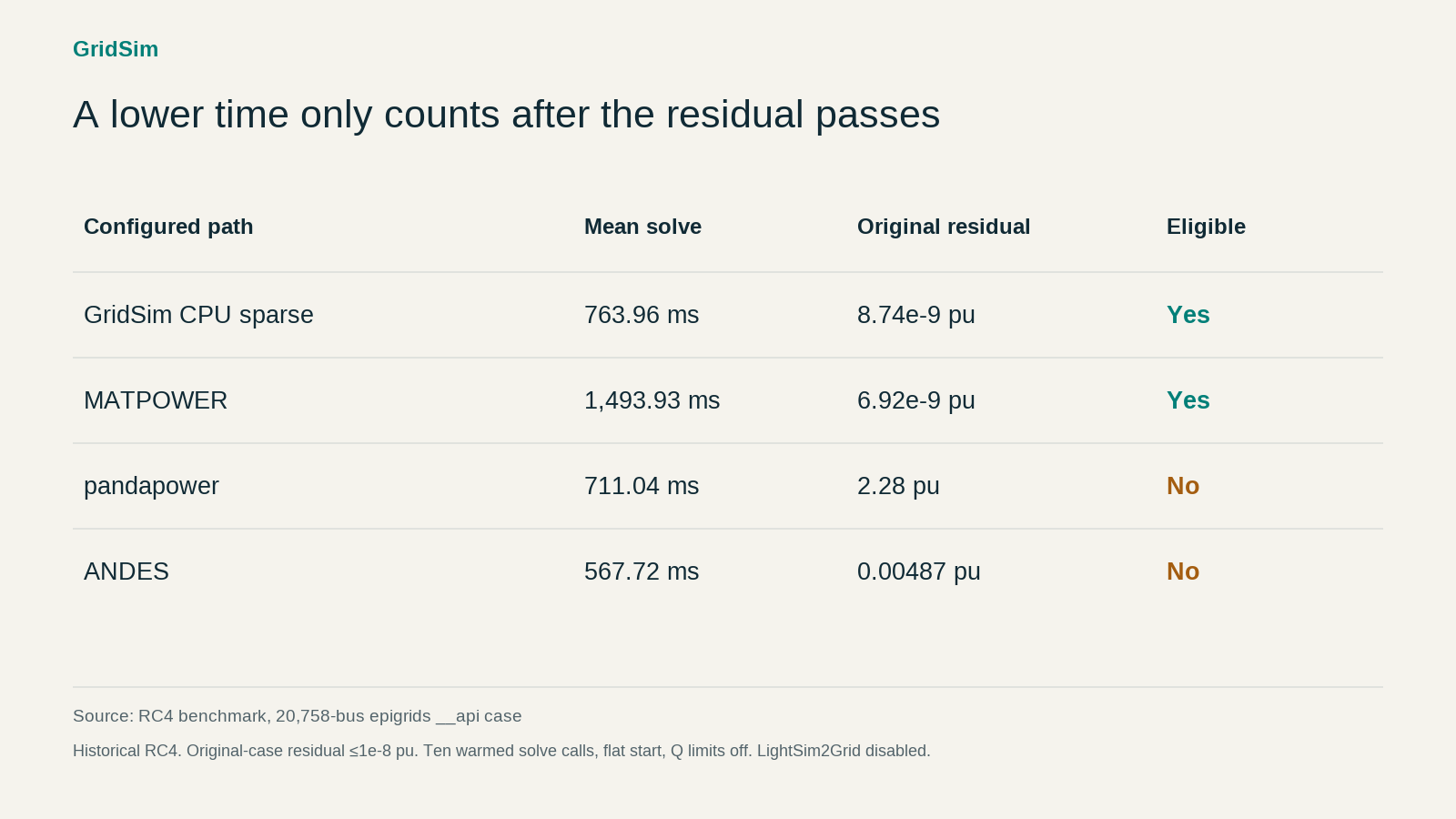
02 / 9 August 2019 GB event replay
The headline measures matched. The trace changed the verdict.
RoCoF −0.171 Hz/s simulated against −0.170 Hz/s recorded; nadir 48.84 Hz against 48.80 Hz. Counterfactuals unlocked.
The headline metrics hold and the nadir time agrees, 76.0 s against 76.1 s, but the sample-by-sample shape misses the bar. The trace-enabled path withheld the counterfactual.
On 9 August 2019 the Hornsea and Little Barford trips, and the losses that followed, took a total of 2,768 MW off the GB system. GridSim's replay rebuilds the event from sourced figures and passes it through a credibility gate before any counterfactual can run. A single-mass swing model with nine power steps in sequence reproduces the excursion's headline physics; adding NESO's published 1-second recording tests the full trajectory, where governor plateau and recovery dynamics differ. Both verdicts stand together, and the gate works as designed.
gridsim replay-event gb-2019-08-0903 / 22 December 2023 GB event replay
Measured end to end. Marginal, and the reason named.
GB lost about 1,000 MW of IFA interconnector import, and the Cottam CCGT, 345 MW, about nine seconds later. Frequency fell to 49.275 Hz and stayed below the 49.5 Hz statutory limit for roughly 59 seconds.
This is the first event whose record GridSim measured end to end itself: losses from settlement metering, the operating point from the recorded inertia outturn, the state estimator and the trace, response services from the auction record and the balancing-mechanism recovery from the BOALF record.
The model's own declared-uncertainty envelope isolates the residual to one nameable gap in the public record: the basis of the inertia measurement. Counterfactuals stay locked.
04 / GB model conversion, GridSim 2.0.170
The file opened. The voltage moved.
The full GB case, 3,539 buses with 1,383 on-load tap changers, was solved, written by each case writer, read back and solved again, with every voltage, angle, injection, flow and loss compared bit for bit.
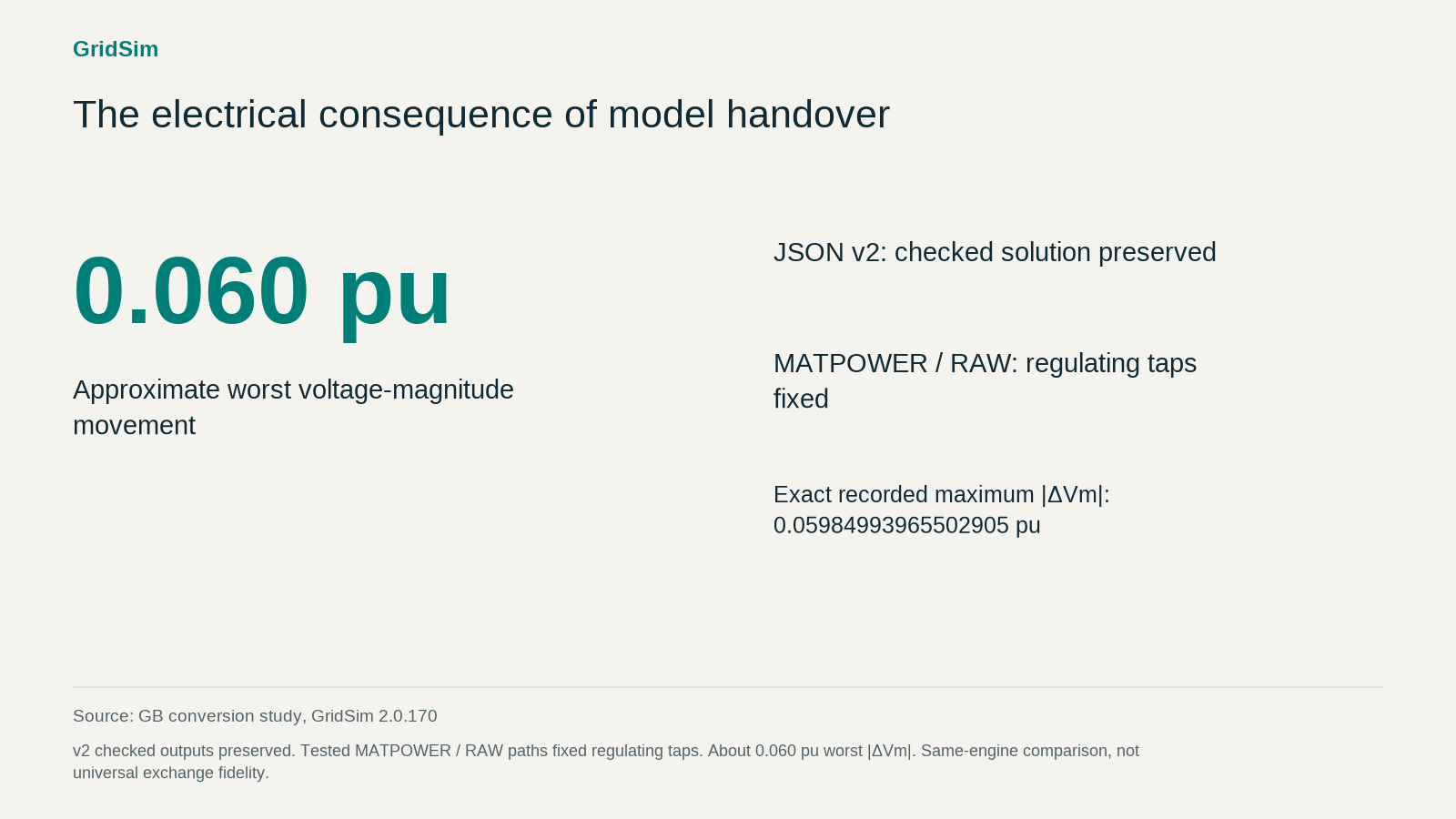
JSON v2 preserved the checked solution, bit for bit. MATPOWER has no tap changers and the RAW 33 bands cannot express them exactly, so those files left every tap at its starting position, where the original solve had moved taps on 936 transformers. The largest voltage-magnitude difference was about 0.060 pu, at bus 4105, and 3,535 of the 3,539 buses moved.
The read-back exposed an electrical consequence that a successful file-open could not.
gridsim convert gb-full <output>The conversion record is docs/validation/studies/gb-full-export-loss-list.md in the repository.
Your next comparison
Bring a baseline you trust.
Define the result that must survive a handover, an upgrade or a change in assumptions.
Choose an evaluation route