Research and experimental work
Make interconnected grid questions testable.
GridSim is an independent, founder-built engineering project.
Research motivation
Put the assumptions where an engineer can inspect them.
Dispatch totals alone do not describe network flows, local dynamics or the effect of a control change.
The platform supports investigations across a network state, a disturbance and a proposed intervention. Measurements, inferred quantities and assumptions enter different parts of the work.
Selected investigation
Local response can differ from the aggregate.
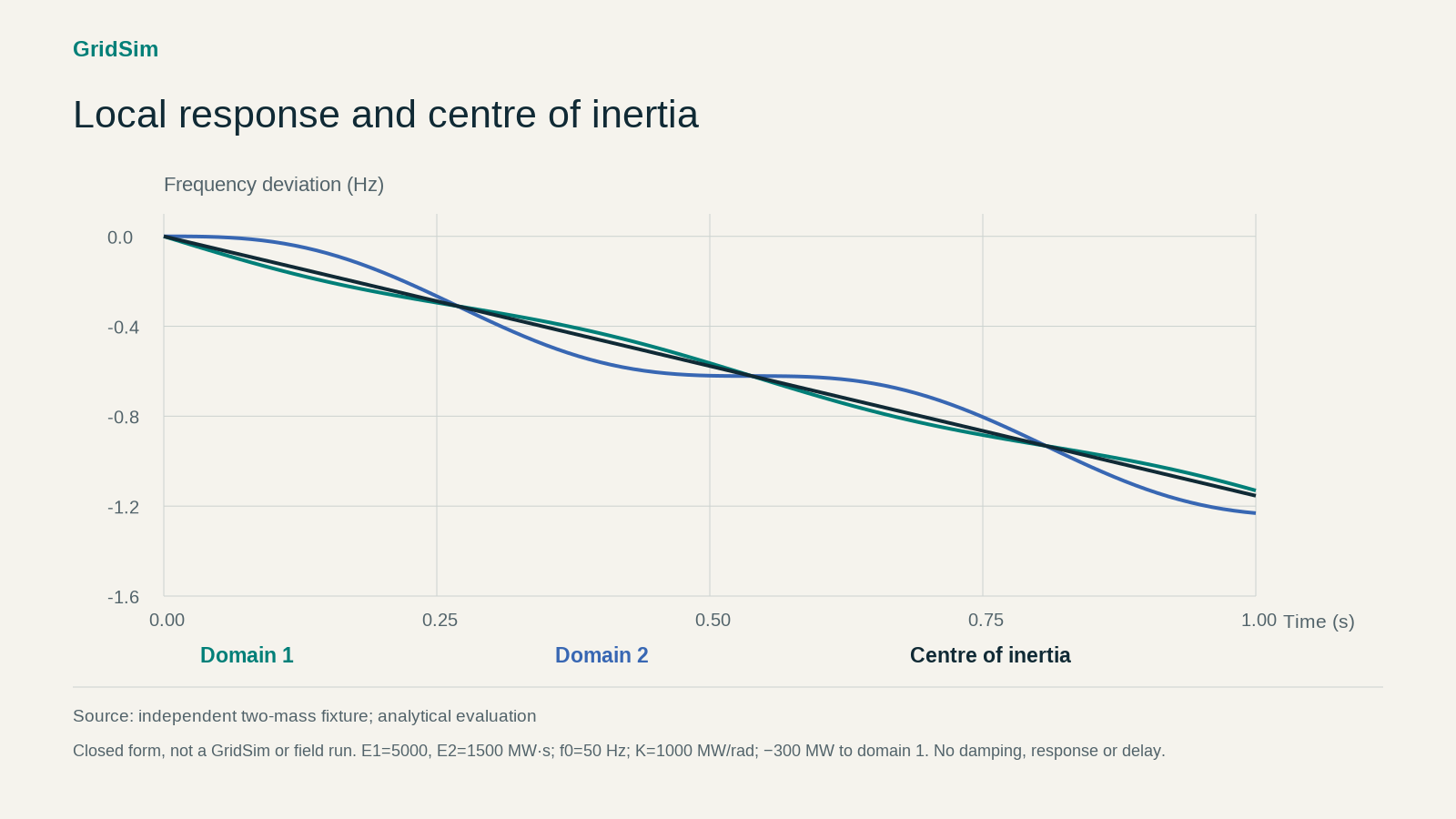
What the reduction shows
For fixed positive inertia, normalised forcing and reciprocal undelayed tie exchange, the internal terms cancel in the aggregate. With the stated shared-response allocation, the centre-of-inertia subsystem recovers the classical small-deviation swing equation.
What it does not show
Aggregate agreement does not bound local numerical error, establish coherent grouping or validate physical behaviour. Pole-count grouping alone is not a modal-coherency proof.
An explicit exception
Delay changes the mathematical balance.
Finite wave speed enters as a retardation on the coupling between domains.
The propagation overlay reads each mass's angle history from a ring buffer, with the delay set by physical distance over a wave speed derived from local inertia density and clamped to the published 500 to 1,500 km/s band.
Delay perturbs the centre of inertia, so the machine-epsilon reduction to the classical swing equation holds only with the overlay off. That is why it ships off by default, and why delayed coupling remains an open research question rather than a verified result.
Documented in docs/validation/distributed-inertia.md in the repository.
Study / inertia placement on gb-full
Can GB run on less inertia if it sits in the right places?
252 RMS runs on the full 3,539-bus GB model, every placement on one build.
The study keeps a quarter of today's 242 GVA.s synchronous fleet in place and adds the rest of each inertia budget as synchronous condensers, placed five ways: where today's inertia is, by demand, at eleven sites along an inverted-T spine in equal shares and with optimised weights, and all at a single London site. Every placement adds the same total inertia; only where it sits changes. The RMS model uses indicative synthetic machine data, so the numbers show the shape of the answer.
gridsim inertia-placement gb-full --json study.jsonThe full study is docs/validation/studies/inertia-placement.md in the repository.
- At about 240 GVA.s, placement buys almost nothing. Any sensible spread gives a worst-bus RoCoF only 11 to 15 % above the system figure. Only concentrating everything in one place costs.
- Placement matters more as inertia rises. For a strict 0.125 Hz/s regional limit, the spine sites need 560.8 to 582.7 GVA.s where today's geography needs 944.1: 38 to 41 % less inertia for the same worst-bus RoCoF.
- The 3 to 5 second window is not placement's to give. Time to 49.8 Hz is a system-frequency quantity, 675 GVA.s for 3 s and 1,125 for 5 s with no response, the same for every placement.
- The gain comes from the electrical ends, the far north of Scotland and Cornwall, which today's geography leaves thin.
A useful research starting point
Compare the local error as well as the mean.
Use a declared model, explicit parameter sources and an independent reference where available. Check step refinement, the aggregate balance and the assumptions behind local response.
Start a research evaluation